

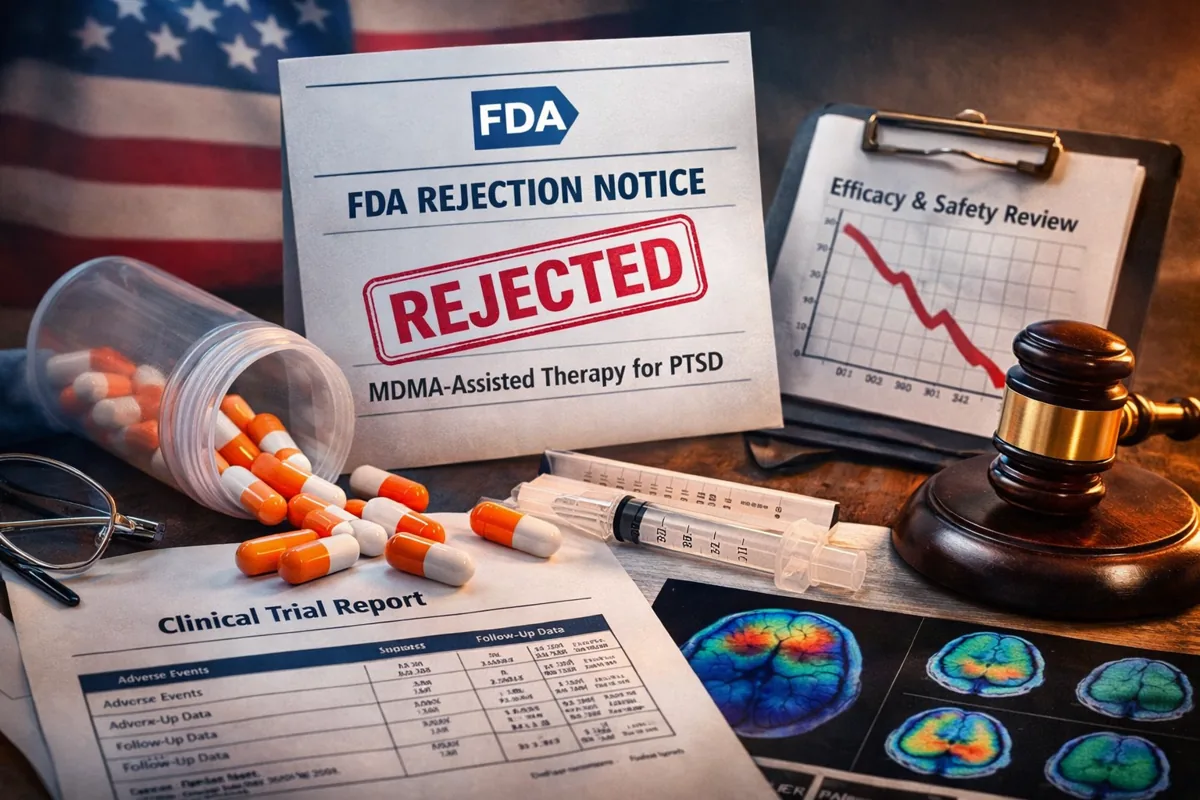
The MDMA Backlash and Tougher Regulatory Standards: Why Psychedelic Medicine Just Entered Its Hardest Phase
The MDMA backlash and tougher regulatory standards story is not really about one bad week for one company. It is about a field being forced to grow up in public. For years, psychedelic medicine was powered by a potent mix of encouraging early data, cultural momentum, investor optimism, and genuine desperation for better mental health treatments. Then the FDA rejection of MDMA-assisted therapy for PTSD cut through the mood with a harsher question: are these trials actually rigorous enough to support approval? The answer, at least from U.S. regulators, was that promise is not the same thing as proof.
That distinction now defines the conversation. FDA’s own 2023 psychedelic guidance said these programs must meet the same evidentiary standard as any other drug, even if psychedelic studies face unusual design problems like functional unblinding, expectancy effects, and the added complexity of psychotherapy. The 2024 MDMA review turned that principle into enforcement. As of April 2026, MDMA-assisted therapy still has not been approved in the United States, and the field remains stuck with the consequences of that decision.
What the FDA rejection actually changed
The easiest mistake here is to reduce the FDA rejection of MDMA-assisted therapy for PTSD to politics, stigma, or anti-psychedelic bias. That reading is emotionally satisfying, but strategically weak. The agency’s advisory committee and later Complete Response Letter pointed to concrete problems: concerns about whether safety data were captured reliably, whether efficacy could be interpreted cleanly in the presence of functional unblinding and expectancy bias, whether benefits were durable enough for a chronic condition like PTSD, and whether the enrolled population was representative enough to support generalization.
That is why the backlash has been so severe. The FDA advisory committee voted 9-2 against concluding the data showed effectiveness and 10-1 against concluding the benefits outweighed the risks under the proposed REMS framework. Those are not narrow warning signals. They are the kind of votes that tell every psychedelicdeveloper, investor, journalist, and advocate that the old “breakthrough narrative” is no longer enough.
Why rigor became the hottest argument in the space
The center of the new debate is not whether MDMA has therapeutic effects. Even skeptical regulators acknowledged the studies looked clinically meaningful on the surface. The problem is whether the studies were built in a way that lets regulators trust what they are seeing. FDA’s briefing materials said the two controlled trials appeared positive, but they also emphasized that the interpretation was difficult because of likely functional unblinding and expectation bias. In plain English: if patients and therapists can often tell who got the active drug, the measured benefit may be inflated in ways that are hard to quantify.
That concern is not unique to MDMA. FDA’s psychedelic guidance explicitly warns that traditional placebo controls can be problematic because subjects receiving an active psychedelic may become functionally unblinded, while placebo recipients in a high-expectancy setting may experience a nocebo effect. The guidance says sponsors should think about alternatives such as subperceptual doses or other psychoactive comparators, use blinded central or video raters, and measure blinding integrity with questionnaires. A 2023 NEJM perspective and later 2025 commentary push the same point: if psychedelic trials cannot handle expectancy and unmasking better, the field will keep arguing about signal versus bias instead of settling the question.
The trial design weaknesses that now matter most
First, safety capture became a serious credibility problem. FDA’s Complete Response Letter said the sponsor’s training materials and safety manual described adverse events in a way that excluded “positive” or “favorable” effects, even though abuse-related events such as euphoria or mood changes still matter for labeling, impairment, and abuse-potential assessment. That was not a cosmetic issue. The agency said this failure limited its ability to assess safety, acute effects, duration of impairment, and abuse signals.
Second, durability became a deal-breaker. PTSD is a chronic condition. FDA said the available data did not show durable benefit beyond the acute study period, and that the follow-up study was too weak to answer the question because it relied on a single visit, highly variable timing, partial enrollment, and possible contamination from outside treatments used in the interim. That matters because regulators do not just ask whether a treatment works at one moment. They ask how it should be used in the real world, whether retreatment is needed, and what belongs on the label.
Third, selection bias and expectancy became impossible to ignore. The CRL said about 40% of enrolled participants reported prior MDMA use, much higher than the background use the agency expected in the indicated PTSD population. FDA argued that this could both limit generalizability and increase expectation bias, because prior users may recognize the drug more easily and anticipate benefit. That is brutal for interpretability. A trial can look statistically clean and still be structurally vulnerable if the participants are unusually able to identify treatment assignment.
Fourth, psychotherapy itself became part of the regulatory problem. FDA’s 2023 guidance says the contribution of psychotherapy to psychedelic treatment effects had not been characterized as of publication, and warns that psychotherapy can increase expectancy and performance bias. It even suggests that factorial designs may help separate the contribution of the drug from the contribution of therapy. That is one of the hardest truths psychedelic advocates have had to face: when a treatment is marketed as “drug plus therapy,” regulators still want to know what exactly the drug is adding.
The new standard is not anti-psychedelic. It is anti-handwaving.
This is where a lot of commentary goes soft. The industry keeps acting surprised that a novel treatment paradigm is being asked to survive ordinary drug-review logic. It should not be surprised. FDA’s guidance says clearly that psychedelic development programs are subject to the same regulations and same evidentiary standards as other drugs. What changed after the MDMA rejection is that this stopped being a theoretical sentence inside a guidance document and became the field’s operating reality.
In fact, the agency did not merely say “come back later.” It sketched what a stronger path could look like: a new randomized, double-blind study with blinded long-term follow-up, pre-specified retreatment criteria, monthly follow-up assessments, baseline expectancy measurement, end-of-study assessments of participant and rater unblinding, and possibly a low-dose MDMA arm as a control. FDA also recommended an independent third-party audit of study records and treatment-session recordings because of concerns about data reliability and study conduct. That is tougher, yes. It is also unusually specific.
What better psychedelic trials will need to look like now
The MDMA backlash and tougher regulatory standards era will reward teams that stop treating methodology like an annoying footnote. The next generation of psychedelic trials will need stronger controls, better blinding strategy, cleaner adverse-event capture, more objective raters, tighter therapist standardization, stronger diversity, and a credible durability plan. FDA’s guidance also calls for two monitors during treatment sessions, clear consent language around vulnerability and suggestibility, and planning around repeat dosing, abuse potential, and post-market risk controls.
That will slow the field down. It may also save it. Weak approvals do not just create access; they create backlash, reputational damage, payer skepticism, clinician hesitation, and years of avoidable distrust. A field that wants mainstream legitimacy cannot rely on “the effect sizes look large” when the surrounding architecture is contested. It needs trials that hostile readers still find hard to dismiss. That is the real meaning of tougher standards.
Why this matters beyond MDMA
The FDA rejection of MDMA-assisted therapy for PTSD cast a longer shadow because it reached beyond one molecule. It warned every psychedelic developer that enthusiasm will not rescue a messy package. Psilocybin, LSD-derived programs, and next-wave compounds now move forward in an environment where regulators, journals, investors, and clinicians are all watching for the same vulnerabilities: functional unblinding, expectancy inflation, therapy confounds, safety-monitoring gaps, weak follow-up, and overconfident storytelling. The field is not dead. But the age of regulatory innocence is over.
Final takeaway
The smartest reading of this moment is not that psychedelic medicine hit a wall. It is that psychedelic medicine finally met the adult version of drug development. The MDMA backlash and tougher regulatory standards moment hurts because it exposed the distance between inspiring outcomes and approvable evidence. But if the field learns the right lesson, this setback could become its most productive correction. The companies that win from here will not be the loudest believers. They will be the ones that design studies strong enough to survive disbelief.
Frequently Asked Questions
These answers explain why the FDA rejection of MDMA-assisted therapy for PTSD changed the conversation around psychedelic medicine and why tougher clinical trial standards now matter more than ever.
