Psilocybin Drug Approval: Why the Race Just Became More Serious
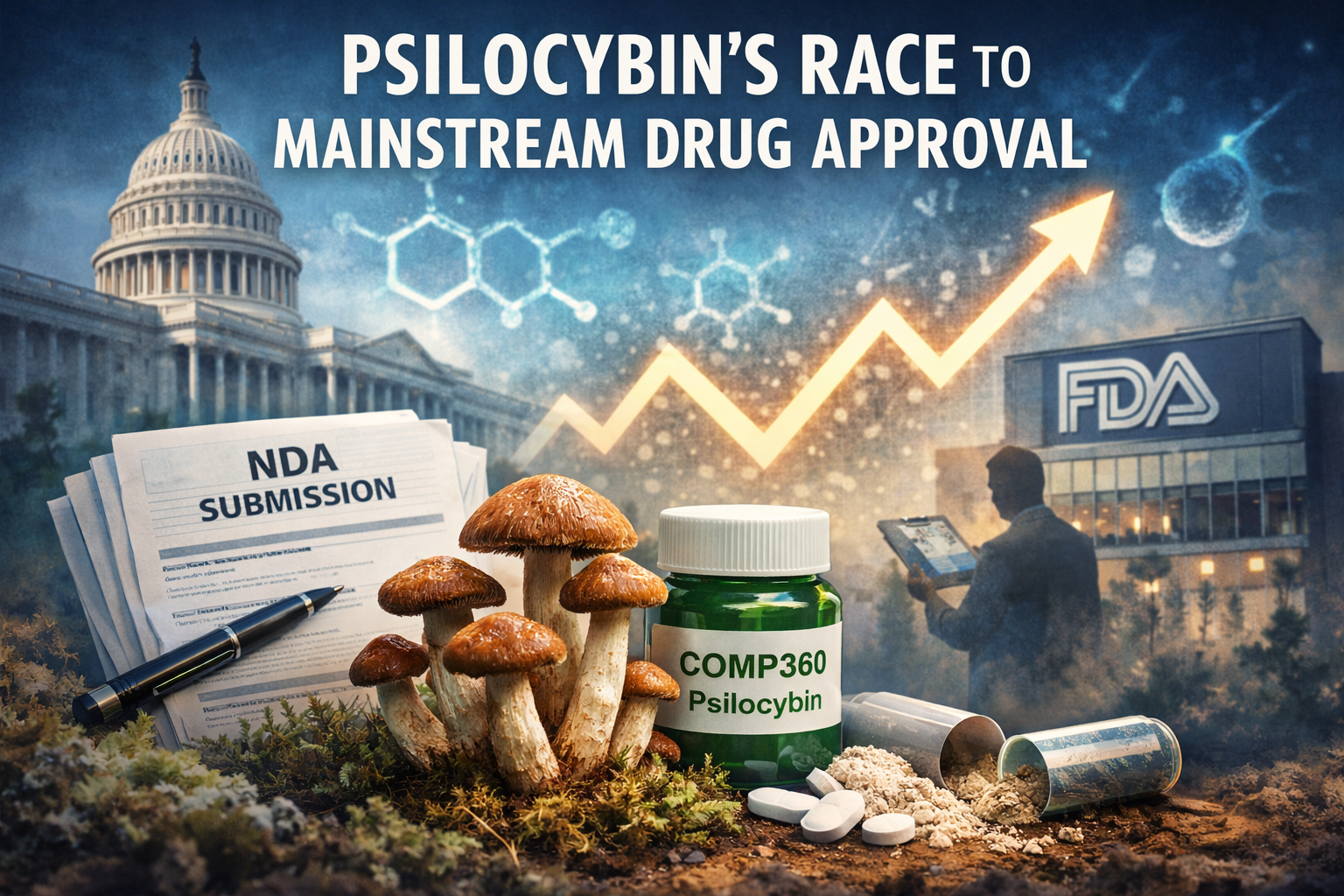
The race for psilocybin drug approval has entered a more consequential phase. For years, the psychedelic medicine story was driven by promise, headlines, and early-stage enthusiasm. Now the conversation is shifting toward hard regulatory math. That shift is happening because psilocybin for treatment-resistant depression is no longer just an intriguing research idea. After Compass Pathways reported a second positive Phase 3 result for COMP360 in February 2026, the company said it had requested an FDA meeting to discuss a rolling submission and review and expects to complete its NDA submission in Q4.
That matters because regulators do not approve cultural excitement. They approve evidence packages. And right now, the strongest late-stage package in this space belongs to the program most directly tied to Compass Pathways Phase 3 data. In June 2025, Compass reported that its first Phase 3 study, COMP005, met its primary endpoint, showing a highly statistically significant and clinically meaningful reduction in symptom severity at week 6. In February 2026, the second pivotal study, COMP006, also met its primary endpoint, with two 25 mg doses outperforming 1 mg on the MADRS depression scale at week 6.
Why Psilocybin for Treatment-Resistant Depression Is Leading the Field
Not every psychiatric indication is equally suited for a first approval. Psilocybin for treatment-resistant depression has become the front-running target because the unmet need is obvious and the clinical-development path is more legible than it was a few years ago. Compass describes COMP360 as a synthetic, proprietary formulation of psilocybin under investigation for difficult-to-treat mental health conditions, with two pivotal Phase 3 trials in treatment-resistant depression. The company also says COMP360 holds FDA Breakthrough Therapy designation for TRD, which signals the agency sees enough preliminary promise to provide closer development guidance.
That does not guarantee approval. It does, however, change the seriousness of the conversation. A lot of psychedelic coverage still sounds like the field is trying to win an argument about legitimacy. That is already outdated. The real issue now is whether the data behind COMP360 FDA approval can survive the final layers of regulatory review, manufacturing scrutiny, safety interpretation, and commercialization planning. That is a much narrower question, and a more useful one.
What the Compass Pathways Phase 3 Results Actually Show
The first Phase 3 trial, COMP005, was a randomized, double-blind, placebo-controlled study that dosed 258 participants across 32 U.S. sites. Compass reported that a single 25 mg dose of COMP360 produced a mean difference of -3.6 points versus placebo on MADRS at week 6, with p<0.001. The company also said the independent Data Safety Monitoring Board found no unexpected safety findings and no clinically meaningful imbalance in suicidal ideation between treatment and placebo arms.
The second Phase 3 trial, COMP006, raised the bar because it showed the first result was not a one-off. In that study, two doses of COMP360 25 mg administered three weeks apart were compared with 1 mg. Compass reported a mean difference of -3.8 points on MADRS at week 6, again with p<0.001. It also said the 25 mg arm showed statistically significant rapid onset from the day after administration, with effects maintained through measured timepoints to week 6.
This is where the approval story gets sharper. One positive trial can trigger hope. Two positive Phase 3 trials start to build a case. Compass now says COMP360 is the first classic psychedelic to consistently achieve a highly statistically significant result and clinically meaningful effect in this setting, while also describing the safety profile across the Phase 3 program to date as generally well tolerated with no unexpected findings.
Why COMP360 FDA Approval Is Now a Serious Regulatory Story
The most important change is not symbolic. It is procedural. Compass has moved from proving signal to preparing submission. In its March 24, 2026 business update, the company said it is scheduled to meet with the FDA to confirm the NDA submission strategy, including a rolling submission and review. It also said 26-week data from COMP006 in early Q3 2026 is expected to be the final dataset for NDA submission.
That is the practical meaning of a live COMP360 FDA approval narrative: the sponsor is no longer talking only about trial readouts; it is talking about the submission architecture, the remaining dataset, and commercial readiness. Compass also said it is advancing launch readiness efforts and expects to be launch-ready by the end of 2026. Whether regulators agree is a separate issue, but the company’s posture is now unmistakably regulatory rather than speculative.
The Center of Gravity Has Shifted Toward Psilocybin Drug Approval
The center of gravity in psychedelic medicine has shifted toward psilocybin not because the field suddenly became less controversial, but because late-stage evidence now carries more weight than cultural fascination. That is an inference from where the strongest public data and clearest regulatory planning now sit. Compass has two positive Phase 3 readouts in treatment-resistant depression, an FDA meeting on submission strategy, and a stated expectation to complete an NDA submission in Q4. In biotech, that is what a serious approval campaign looks like.
There is also a market argument behind this push. Compass said in its March 2026 update that of the approximately 4 million treatment-resistant depression patients in the United States, fewer than 200,000 receive an FDA-approved treatment indicated for TRD. Even if you treat company market estimates cautiously, the strategic signal is obvious: a large unmet-need population exists, and a therapy that appears rapid, differentiated, and durable will get attention from regulators, clinicians, and investors alike.
The Hard Part Is No Longer Awareness. It Is Psychedelic Therapy Regulation.
This is where weak articles usually fall apart. They act as if positive data automatically becomes approval. It does not. Psychedelic therapy regulation is difficult precisely because these treatments are not judged only on symptom change. Regulators will also care about trial design, monitoring protocols, safety management, consistency of administration, manufacturing controls, and how treatment works outside tightly managed research settings. Compass itself says forward-looking statements about approval, commercial launch timelines, and reimbursement are subject to uncertainty.
That means the remaining challenge is not philosophical acceptance of psychedelics. It is execution. Can the sponsor turn strong efficacy signals into a submission that satisfies regulators on safety, reliability, and real-world feasibility? Can the treatment model be standardized enough that approval does not create operational chaos? Those questions sit at the heart of psychedelic therapy regulation, and they will determine whether this moment becomes a milestone or just another promising near-miss. The data has pushed psilocybin closer to the door. Regulators still decide whether it walks through.
What Happens Next
The next key milestone is the 26-week COMP006 dataset expected in early Q3 2026, which Compass has called the final dataset needed for its NDA submission. After that, the focus shifts to the FDA meeting outcomes, the structure of the submission, and whether the agency accepts the application on the path the company is now outlining. Until then, the most honest conclusion is this: psilocybin drug approval is no longer a fringe thought experiment. It is an active regulatory contest centered on psilocybin for treatment-resistant depression, powered by Compass Pathways Phase 3 results, and increasingly defined by the credibility of the COMP360 FDA approval pathway and the realities of psychedelic therapy regulation.
Conclusion
The smartest way to read this moment is without hype and without cynicism. Psilocybin has not been approved, and there is still real regulatory work ahead. But the field has crossed an important line. The conversation is no longer mainly about whether psychedelic medicine can produce meaningful clinical effects. The conversation is now about whether one of these therapies can meet the standards required for mainstream medicine. Right now, Compass has pushed that question further than anyone else in the sector. And that is why the race for psilocybin drug approval suddenly looks real.
FAQ
Is psilocybin FDA approved for depression?
No. As of 2026, there are no approved psychedelic treatments for any psychiatric condition in the United States. Compass Pathways’ COMP360 remains investigational, although the company is moving toward an NDA submission for treatment-resistant depression.
Why is treatment-resistant depression the main target for psilocybin approval?
TRD is a major unmet-need category, commonly defined as inadequate response to at least two appropriate antidepressant trials. Psilocybin also has one of the most advanced evidence packages in the field, including Breakthrough Therapy designation and two positive Phase 3 readouts from Compass.
When could psilocybin be approved?
Compass says the final COMP006 dataset is expected in early Q3 2026 and has said it expects to complete its NDA submission in Q4. Analysts cited by Reuters have pointed to 2027 as a plausible approval window, but that is an external estimate, not an FDA decision.
What is the biggest obstacle to psilocybin approval now?
The biggest obstacle is not proving that patients can feel something. It is proving to regulators that the measured benefit is reliable, safe, and not overly distorted by expectancy bias, functional unblinding, or poorly standardized therapy and monitoring conditions.